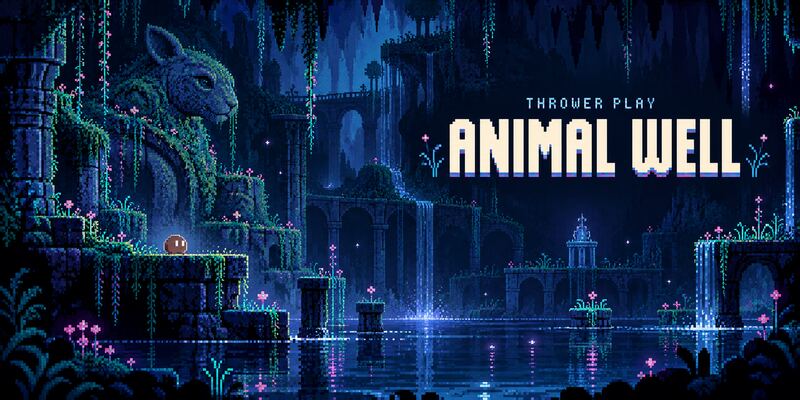
THROWER PLAY – An unfamiliar sound, an oddly placed object, a passage that seems just beyond reach—small details can create a powerful reason to keep exploring. Animal Well builds its adventure around that impulse. It invites you to notice something unusual, form an idea, and discover what happens when you act on it.
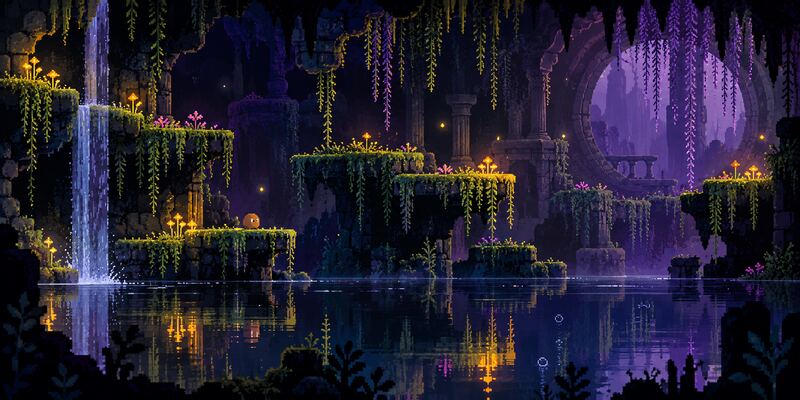
Developed by Billy Basso and published by Bigmode, Animal Well was released on May 9, 2024. Its interconnected labyrinth combines exploration, environmental puzzles, and encounters with creatures whose behavior demands attention. The experience grows through discoveries that change how you understand your surroundings.
That makes it particularly interesting for players who enjoy figuring things out for themselves. A successful discovery can leave you with more than a newly opened route. It can give you an idea that changes how you approach rooms you thought you already understood.
A Small Arrival in a Strange World
Animal Well begins with an unusual introduction: your character hatches from a flower and enters a world already inhabited by other creatures. The setting combines inviting beauty with unsettling encounters, leaving you to assess what is safe as you explore.
This starting point establishes an important relationship between the player and the environment. You arrive as a small presence within a place that has its own rhythms. Understanding those rhythms becomes part of finding your way.
The perspective creates room for several emotions at once. A creature can be charming at a distance and intimidating when it moves closer. An unexplored opening can promise discovery while making you hesitate. Curiosity and caution remain closely connected.
That balance gives exploration its momentum. You want to know what lies ahead, but approaching carefully can reveal information that rushing would cause you to miss. The world invites attention through the uncertainty of what might happen next.
A Map Built to Be Remembered
Animal Well’s world is designed around density and interconnected spaces. Basso has explained that returning to familiar areas can reveal new possibilities through either an acquired ability or a better understanding of what is already there. The screen-by-screen camera also encourages players to examine each room as a complete arrangement.
This gives memory a practical role. A distinctive room, an inaccessible ledge, or a suspicious arrangement of objects may become useful information later. Exploration includes building a mental picture of how places relate to one another.
Recognizing a connection can be satisfying in its own right. A route that once seemed confusing becomes familiar. A location that felt isolated finds its place within a larger structure. Your understanding gradually catches up with the world’s design.
Returning to an earlier area therefore carries a particular kind of anticipation. You bring a different perspective to the same surroundings. A detail that previously seemed unimportant may now suggest a question worth investigating.
Familiar Objects with Unexpected Possibilities
The game’s equipment includes recognizable objects such as a yo-yo and a flying disc. These sit within a system of items designed to have multiple uses and interact meaningfully with the environment.
Their familiarity is part of the attraction. You arrive with assumptions about what an ordinary object might do, then test those assumptions against the game’s rules. Discovering another use can change how valuable an item feels without changing the item itself.
This encourages a practical form of creativity. Before abandoning an idea, consider the object’s movement, timing, or relationship with the surrounding space. A different position or sequence of actions may produce a different result.
The strongest reward in this kind of puzzle design is understanding why something works. Once you recognize a useful interaction, you can look for other situations where the same principle might apply. A local discovery becomes knowledge you carry through the rest of the adventure.
Animals Give the Environment Its Personality
Animal Well’s creatures are central to its identity. Basso describes a setting inhabited by animals such as dogs, mice, kangaroos, capybaras, and chinchillas. They respond to their surroundings, and navigating the world may involve working with their behavior or finding a way around it.
That makes an encounter an opportunity to observe. Watch how a creature moves, what attracts its attention, and how the space around it affects the situation. Its behavior can be as important as the platforms and objects nearby.
The resulting tension comes partly from vulnerability. The game’s official description emphasizes survival through clever use of items and the environment. Understanding a situation gives you more options when direct movement becomes dangerous.
There is also a distinctive charm in sharing space with creatures that seem occupied by their own concerns. Their presence helps the labyrinth feel inhabited. Even a brief encounter can become a memorable landmark when an animal’s size, movement, or reaction gives the room a recognizable character.
Pixel Art with Depth and Movement
Animal Well’s visual style uses detailed lighting and environmental effects alongside its pixel art. Basso built the engine and editor himself, incorporating techniques that allow light to respond to surfaces and simulations that contribute to effects such as water and smoke.
The significance of those choices is visible in how the environment presents itself. Light can draw attention toward part of a room while leaving another area uncertain. Movement in the scenery makes a space feel active even when the player pauses.
For an exploration game, that pause matters. The player needs time to inspect the surroundings, and visual detail gives the eye something to consider. Atmosphere becomes part of the act of looking.
The combination also makes familiar pixel shapes feel slightly unusual. Their outlines may be easy to read, while their interaction with light and movement gives them a sense of depth. That mixture suits a world whose appeal depends on recognizable things behaving in unexpected ways.
Secrets That Support Different Levels of Curiosity
Animal Well contains multiple layers of secrets. During development, Basso described designing for several kinds of players: those interested in reaching the ending, those who enjoy searching thoroughly, and those drawn to more obscure relationships between details throughout the world.
That distinction helps set useful expectations. Enjoying the central adventure does not require approaching every room with the same intensity as someone determined to investigate every mystery. Different levels of curiosity can lead to different experiences within the same setting.
It also gives players room to change their approach. You might begin by following the routes that seem most promising, then become interested in a peculiar detail that sends you back through familiar territory. An optional investigation can become a personal goal.
The appeal of this structure depends on the pleasure of uncertainty. Some players enjoy holding several unanswered questions at once. Others prefer clearer direction. Animal Well asks you to spend time with questions before knowing which ones you can answer immediately.
Exploring Without Giving Away the Discovery
A useful approach is to give each idea enough attention to understand what it teaches you. When an experiment fails, notice whether it revealed something about timing, movement, or an object’s behavior. Even an unsuccessful attempt can narrow the possibilities.
Keeping brief notes can help when several mysteries compete for attention. Record what seemed unusual and where you encountered it. Separating an observation from a theory makes it easier to reconsider your assumptions later.
There is also value in stepping away from a difficult room. Exploring elsewhere may introduce an item or an interaction that changes your understanding. Returning with a fresh idea can be more productive than repeating an approach that has stopped providing information.
Basso encourages players to share discoveries with a small group of friends before consulting the wider community. That offers a way to exchange ideas while preserving some of the satisfaction of working things out together.
The Pleasure of Knowing a Place
Animal Well’s appeal grows from the changing relationship between the player and the labyrinth. At first, a room presents unfamiliar objects and uncertain possibilities. Later, the same room may become a recognizable junction, a useful shortcut, or the setting for a discovery you remember clearly.
That familiarity never needs to erase curiosity. Knowing how to navigate a place can make its remaining oddities stand out more clearly. Confidence gives you room to notice what you previously overlooked.
The adventure leaves space for that gradual change. You observe, experiment, remember, and return. Eventually, a detail catches your attention in a familiar room, and an idea suggests itself. You reach for an item, try something new, and wait to see how the world responds.




 GTA: VICE CITY STORIES